Online microneedling course UK, what to expect
By Lee Jameson-Laffey · 28 April 2026 · 4 min read
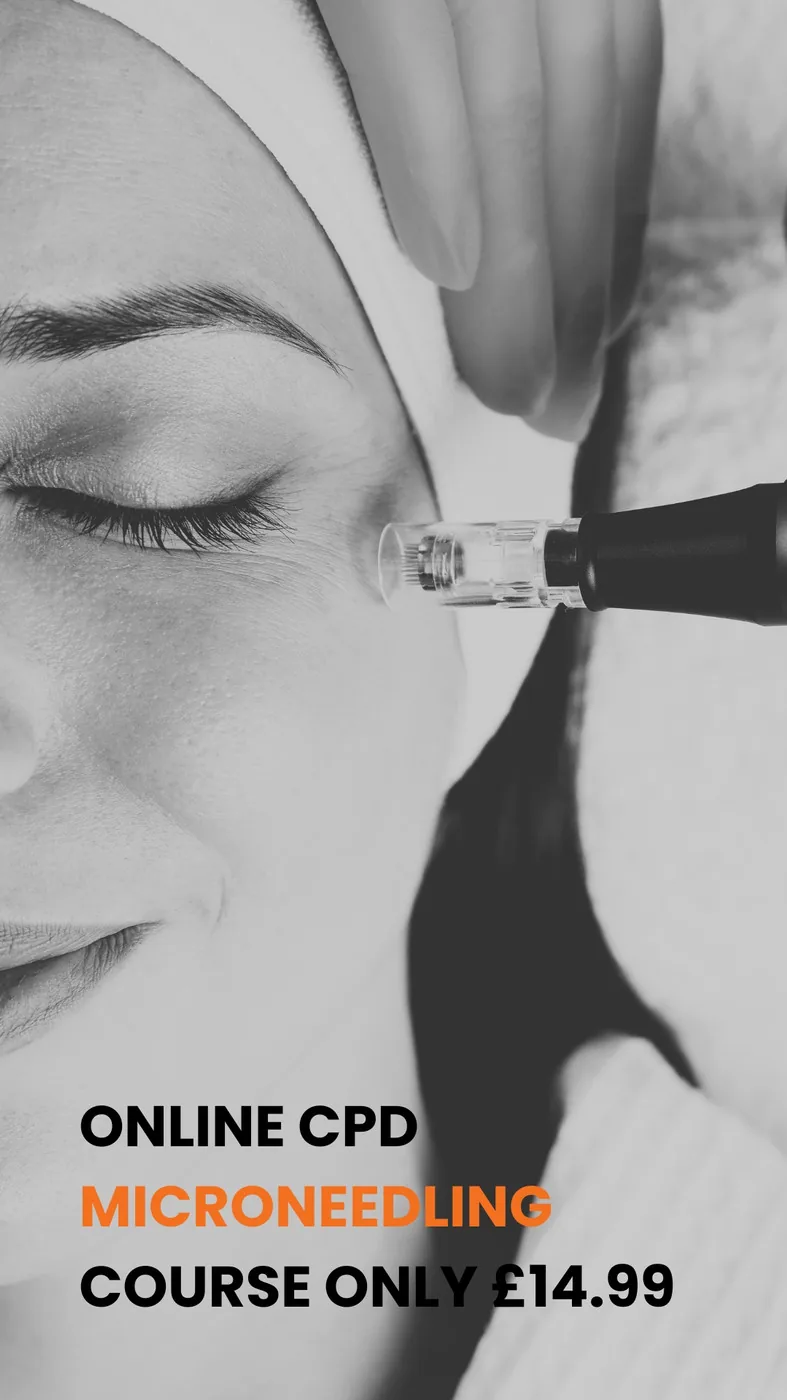
Microneedling is one of the most-asked-for treatments in clinic, and one of the most over-promised online. If you're considering an online microneedling course in the UK, whether you're moving across from another modality or training from scratch, it's worth knowing what a serious programme actually looks like before you part with a fee.
This post walks through the structure of a credible online microneedling course, what you should expect to learn, what you shouldn't expect to learn online, and how to tell whether the qualification will hold up when an insurer or a regulator looks at it.
What an online microneedling course can teach you
The theory side of microneedling is well-suited to remote study. You can cover the science of the procedure in a structured, self-paced way without losing anything by being away from a clinic.
A solid online module should walk you through the layered structure of the skin, the wound-healing cascade triggered by controlled micro-injury, and the way collagen and elastin remodel in the weeks after treatment. It should explain the difference between cosmetic devices and medical-grade pen depths, how needle length maps to indication, and where the evidence currently sits on results for acne scarring, mild hyperpigmentation, stretch marks, and general skin quality.
You should expect modules on consent and consultation, how to take a meaningful medical history, contraindications (active acne, isotretinoin within the past six months, keloid tendency, active herpes flare, immunosuppression, pregnancy), and the post-treatment timeline you'll be guiding clients through. Aftercare is not a leaflet at the end. It is central to the result, and it should be central to the course.
Infection control, sharps handling, single-use cartridges, and waste disposal also belong in the theory portion. These are not optional add-ons. They are the part inspectors and insurers want to see covered.
What an online course shouldn't pretend to teach
Online learning works for the knowledge layer. It does not, on its own, make you safe to needle a face.
Be wary of any provider that promises full certification, including practical sign-off, purely through video. Pressure, angle, glide speed, and recognising a genuine end-point on different skin types are tactile skills. You learn them with a trainer in the room, ideally on live models, with someone watching your hand.
A well-designed UK course will be honest about this split. The online portion gives you the science and the framework. The practical day, run separately, is where you're observed performing the treatment and signed off competent. If a course collapses both into a single Zoom call, that's a flag.
How to tell if the course is CPD-accredited and insurance-friendly
CPD accreditation is the baseline most UK insurers and clinics expect. It means an independent body has reviewed the course content and confirmed it meets a defined standard of continuing professional development. It does not, on its own, make you a regulated practitioner, but its absence makes things harder.
Check that the certificate names the accrediting body, that the body is recognisable (CPD Certification Service, CPD Group, or equivalent), and that the certificate states the CPD hours awarded. Ask the provider directly which UK insurers have accepted their qualification in the past twelve months. A credible provider will answer that question without hedging.
Also check whether the course assumes a prerequisite. For many medical-grade microneedling pathways in the UK, that's a healthcare background (NMC, GMC, GDC, GPhC, or equivalent), or a Level 4 beauty therapy qualification with appropriate additional training. The course should be explicit about who it's designed for and who it's not.
What a realistic timeline looks like
A reasonable online microneedling course covers six to ten hours of structured study, plus assessment. You should be able to complete it in two or three sittings, return to specific modules, and have ongoing access to materials so you can revisit anatomy or aftercare protocols when a client question lands six months later.
If a course advertises ten minutes of content and a certificate, the certificate is worth what you paid for it. If it advertises forty hours of online study, it's likely padded. The middle is where the credible work sits.
After the online portion, expect a separate practical day, usually four to six hours, on models, with case-based discussion built in. That's where most of the genuine learning happens, and it's the part you can't compress.
Choosing a UK provider you can stand behind
The names on your certificate end up on your clinic wall. They get checked when a client asks, when an insurer renews, and when a complaint, eventually one will, needs answering. Pick a provider whose practical work you've seen, whose trainers are practising clinicians rather than full-time educators, and whose support continues past the certificate.
Our online aesthetic training programmes are built around exactly that split: structured science and protocol up front, practical sign-off on a separate day with a clinician trainer. If you'd like to see the in-clinic side of how we run treatments before deciding, you can also have a look at our Durham clinic services. A number of our trainees come through after experiencing the treatment themselves.
If you have questions about whether the course suits your background, ask before you book. A provider who doesn't want that conversation isn't the right provider.
Get in touch
The Aesthetic Surgery, Durham.
Phone: 07432 121701
Email: hello@theaestheticsurgery.uk
Address: Langley Park, Durham, DH7 9TL.
Book a consultation: theaestheticsurgery.co.uk
Online CPD courses: our online microneedling course